


How to Write and Describe Your Extracurricular Activities on Your Medical School Application

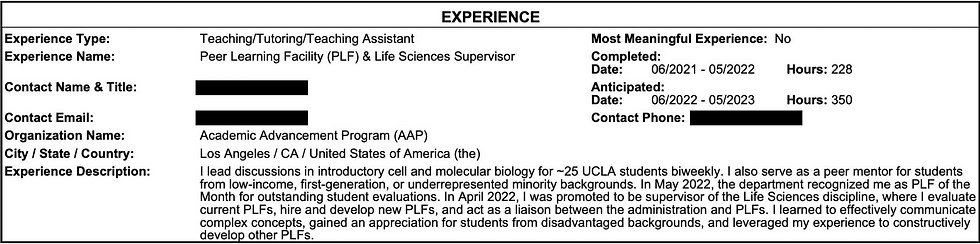
When you're applying to medical school, your extracurricular activities are more than just a list of things you've done. They're an opportunity to showcase your character, passions, and most importantly, your preparedness for the demanding, compassionate, and multidisciplinary nature of a medical career. Medical schools are not only looking for students with academic prowess, but also individuals with strong leadership, interpersonal skills, commitment, and a genuine passion for service. Here's how to craft compelling descriptions of your extracurricular activities, along with some examples to help you write an application that stands out.
1. Start with the Basics: The Who, What, Where, When, and How Much
Before diving into the deeper reflections on what you gained from the activity, it’s important to provide the foundation of the experience. This includes:
What was the activity? Was it a volunteer opportunity, research project, leadership role, community service, or paid job?
Where did it take place? Mention the name of the organization, hospital, lab, or community initiative, if applicable.
How long did you participate? Provide the start and end dates and the weekly time commitment. Medical schools want to see consistency and dedication. Include an approximate number of hours.
What was your role? Were you an active participant, leader, organizer, or researcher? Did you have specific responsibilities? Were you in charge of a team, or were you a mentee learning from others?
Example: Research Assistant in a Cardiology Lab
Activity: Research Assistant
Location: Department of Cardiology, XYZ University Hospital
Dates: September 2021 – May 2023. 700 hours
Time Commitment: 10 hours per week
Role: Research assistant focusing on analyzing patient data and assisting in lab-based experiments.
While this basic information is important for giving context to your involvement, it’s not what will make you stand out. The next step is where you can really shine.
2. Showcase Your Impact: What Did You Contribute?
This is where you get the chance to show how your participation added value to the organization, team, or community. What sets you apart isn’t just the fact that you joined an activity, but how you made it meaningful and impactful.
Ask yourself:
What tasks or responsibilities did I undertake?
How did I go above and beyond my expected duties?
What skills or strengths did I develop or showcase through this activity?
Did I help improve something, solve a problem, or contribute to a specific outcome?
Example: Clinical Volunteer at a Free Health Clinic
Let’s say you volunteered at a free health clinic. Instead of simply stating that you helped with administrative tasks, dig deeper. Explain how your work impacted the clinic and the patients.
Poor Description: "I volunteered at a free health clinic and helped with administrative tasks."
Better Description: "As a volunteer at a free health clinic, I assisted with patient intake and performed basic triage duties, helping to streamline the process and reduce wait times. I took vital signs, documented patient histories, and provided emotional support to underserved populations, gaining firsthand exposure to the social determinants of health and the importance of compassionate care."
In this example, you are showing that you didn’t just show up—you took responsibility and had a direct impact on the clinic’s operations and patient experience. Plus, you highlight the deeper lessons you learned about health disparities and patient care, which are highly relevant to a future in medicine.
3. More Things You Can Highlight In Your Description
3a. Every activity you describe should be linked to your motivation for pursuing medicine.
Admissions committees want to see that your extracurriculars align with the qualities they value in medical students—empathy, resilience, teamwork, intellectual curiosity, and a deep commitment to service.
Reflect on the why and how of your involvement. Ask yourself:
How did this experience confirm or deepen my desire to become a doctor?
What insights did I gain that will make me a better physician?
How did I develop traits or skills that are important in medicine?
Example: Tutoring High School Students in Biology
Activity: Biology Tutor
Location: Community Center, ABC Neighborhood
Dates: June 2020 – August 2021
Time Commitment: 5 hours per week
Role: Peer tutor for high school students struggling with biology.
Link to Medicine: "Tutoring high school students in biology not only strengthened my own understanding of complex scientific concepts, but also reinforced my desire to teach and mentor others—an essential aspect of being a physician. Explaining difficult topics to students of diverse backgrounds improved my communication skills, which I know will be crucial when interacting with patients and colleagues in the future."
In this example, the applicant ties their tutoring experience directly to skills they’ll need as a doctor, such as teaching, clear communication, and patience. They also reflect on the personal satisfaction that comes from helping others succeed—something that resonates deeply in medicine, where teaching and mentoring are central aspects of the role.
3b. Show Personal Growth: What Did You Learn?
Medical schools aren’t just interested in what you did—they want to know how those activities shaped you as a person and as a future physician. Personal growth is a key element of extracurriculars. This is your chance to reflect on what you learned, how you developed new perspectives, or how you became more self-aware.
Challenges: Did you overcome any challenges or obstacles in your extracurricular work? How did you handle them? Did you ever step outside your comfort zone?
Lessons Learned: What did you learn about yourself, others, or the world? Did an activity deepen your understanding of healthcare, the medical profession, or societal issues? Did it make you more compassionate or more patient?
New Interests: Did your extracurricular activities spark an interest in a specific area of medicine or healthcare?
Example: Shadowing a Physician
Activity: Physician Shadowing (Emergency Medicine)
Location: ABC City Hospital, Emergency Department
Dates: June 2022 – August 2022
Time Commitment: 10 hours per week
Role: Shadowed a physician to observe patient interactions, diagnoses, and treatments.
Personal Growth: "Shadowing Dr. Smith in the emergency department was a transformative experience. I learned how to remain calm under pressure, communicate effectively with patients in crisis, and work as part of a fast-paced, multidisciplinary team. The exposure to high-stress situations confirmed my interest in emergency medicine, where critical thinking and empathy are paramount. I also realized how important it is to care for the whole patient, considering both their medical and emotional needs during acute events."
This reflection illustrates how shadowing isn’t just a passive activity, but one that led to personal growth and clarity in the applicant’s career goals.
4. Be Specific, but Keep It Concise
While you want to provide rich, detailed descriptions of your extracurriculars, remember that space is limited on your medical school application. Admissions committees read thousands of applications, so keeping your descriptions focused, clear, and concise is key.
Avoid generic statements. Instead of saying, "I helped patients," specify how you helped them and what it meant for the patients or the community.
Use active verbs to describe your actions. Words like “led,” “organized,” “collaborated,” and “contributed” make your involvement stand out.
Don’t just describe the activity—reflect on why it matters to you and how it’s prepared you for a career in medicine.
Conclusion
Your extracurricular activities are a window into who you are as a person and why you’re suited for a career in medicine. Rather than simply listing activities, focus on how each one shaped you, developed your skills, and deepened your understanding of the medical profession. By reflecting on your experiences thoughtfully and connecting them to your journey toward becoming a doctor, you’ll present yourself as a well-rounded, passionate, and driven applicant—one who is not only prepared for medical school but also for the challenges and rewards of being a compassionate physician.
So, take a moment to dig deep into each experience, highlight your unique contributions, and most importantly—be yourself. After all, medicine needs people like you who are not only committed but also human.


Comments